

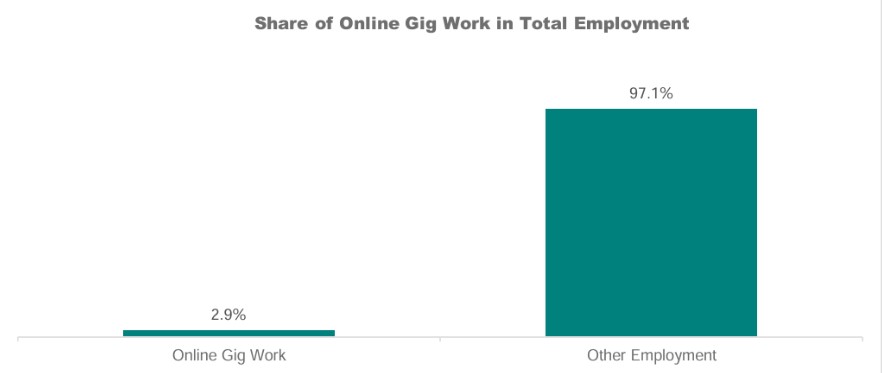
Online Gig Work Accounts only for 2.9% of Total Employment in Pakistan
Wednesday, 25 February 2026
ISLAMABAD: As Pakistan’s labor market evolves under the influence of digital technology, the Pakistan Labour Force Survey (LFS) 2024–25 provides the first nationally representative statistical estimate of digital platform employment, commonly referred to as gig work.
The Labor Force Survey (LFS) 2024–25 is Pakistan’s most comprehensive national survey on employment, labor market structure, and workforce participation. Conducted annually by the Pakistan Bureau of Statistics (PBS), the LFS provides detailed insights into the size and characteristics of the labor force, employment patterns, sectoral distribution, informality, wages, and demographic differentials across age, gender, province, and rural–urban divides.
Gallup Pakistan’s analysis draws exclusively from this PBS-published dataset to translate complex statistical findings into accessible insights to support public understanding and policymaking.
The data reveal that online gig work constitutes 2.9% of total employment in Pakistan, marking the emergence of a measurable, though still modest, segment within the broader workforce. The inclusion of digital platform employment in the LFS reflects Pakistan’s alignment with updated international statistical standards under the 19th and 21st International Conference of Labour Statisticians (ICLS), which recognize evolving forms of work beyond traditional employer–employee arrangements.
What is the Big Data Analysis Series by Gallup?
Gallup Pakistan’s Big Data series was initiated by Bilal I. Gilani, Executive Director of Gallup Pakistan. As he explains: “Pakistan does not suffer from a lack of data, but from limited accessibility and weak translation of numbers into understanding. Gallup Pakistan bridges this gap by analyzing large, often under-used datasets — from PSLM and Labour Force Surveys to Economic Surveys and National Census data — so these statistics can meaningfully inform policy and public discourse.”
What data points this current edition covers
This edition draws on the following datasets from the Pakistan Labour Force Survey 2024–25:
Digital Platform Employment (Chapter 7)
Share of Gig Workers in Total Employment
Distribution of Gig Workers by Type of Activity
Gender Differences in Gig Participation
These indicators provide a nationally representative view of emerging platform-based work arrangements in Pakistan.
Key Findings
1. Online gig work accounts for 2.9% of total employment in Pakistan.
2. Among gig workers, 97.1% are engaged in physical platform-based activities, while only 2.9% perform fully online digital work.
3. 3.0% of employed males participate in online gig work compared to 2.5% of employed females, indicating slightly higher male engagement in platform-based employment.
4. Gig work remains a measurable but still modest segment of Pakistan’s overall labour market, embedded largely within the services sector.
Gig Work Remains a Small but Measurable Segment of the Labor Market
The LFS 2024–25 reports that online gig work accounts for 2.9% of total employment. When placed in the context of total employment of 77.2 million persons under the 19th ICLS framework, this percentage translates into several million workers engaged in platform-mediated activities nationwide.
Although 2.9% may appear modest, its significance lies in its structural implications rather than its immediate scale. Digital platform work did not exist in measurable national statistics a decade ago. Its formal inclusion in the LFS signals institutional recognition of a new employment channel shaped by technology, smartphone penetration, and app-based service delivery systems. Even small shares within a large labor market can represent substantial absolute numbers, and platform-based work has the capacity to scale rapidly in urban economies.
At present, however, gig work does not represent a fundamental restructuring of Pakistan’s employment composition. The majority of employment remains concentrated in agriculture, industry, and traditional services. The data indicate that digital platforms are adding a new layer to the labor market rather than replacing existing structures.
Pakistan’s Gig Economy Is Overwhelmingly Physical Rather Than Fully Digital
A defining feature of Pakistan’s gig economy is its composition. The survey shows that 97.1% of gig workers are engaged in physical platform-based work. This includes ride-hailing services, delivery operations, logistics coordination, and other location-based tasks mediated through digital applications.
Only a small fraction of gig workers are engaged in purely online or remote digital activities such as freelancing, programming, or content-based services. This distinction is important because it reveals that Pakistan’s gig economy is primarily an extension of domestic service delivery markets rather than a transformation toward globally integrated digital labor exports.
In structural terms, this means that Pakistan’s gig economy is anchored in urban transport, food delivery, and logistics systems. It represents digitized coordination of physical labor rather than the large-scale migration of workers into high-skill remote digital employment. The platform serves as an intermediary between consumer demand and worker supply, but the work itself remains location-bound.
This pattern reflects the broader structure of Pakistan’s services sector, where transportation, wholesale trade, and informal service delivery dominate employment growth.
Gender Differences Reflect Broader Labor Market Patterns
The survey indicates that 3.0% of employed males engage in online gig work compared to 2.5% of employed females. While the percentage difference is relatively small, it must be interpreted within the wider context of gender disparities in labor force participation.
Male employment levels in Pakistan are significantly higher than female employment levels overall. As a result, even small percentage differences translate into a substantially larger absolute number of male gig workers. The data therefore suggest that digital platforms have not yet fundamentally altered the gender structure of employment.
At the same time, the relatively narrow percentage gap indicates that gig work may present a somewhat more accessible entry point compared to traditional formal employment. Platform-based work often offers flexible hours and lower entry barriers. However, structural constraints such as mobility restrictions, caregiving responsibilities, and digital access inequalities continue to shape female participation rates.
Thus, while gig work introduces flexibility, it does not automatically eliminate deep-rooted labor market inequalities.
Gig Work Within a Predominantly Informal Employment Structure
To understand the broader implications of gig work, it must be placed within Pakistan’s overall employment composition. The LFS 2024–25 shows that agriculture accounts for 33.1% of employment, industry for 25.7%, and services for 41.2%. Given that most gig work is physical and platform-mediated (e.g., transport and delivery), it is likely embedded within the broader services sector.
At the same time, informal employment remains dominant in Pakistan’s labor market, accounting for 80.8% of total employment under the 21st ICLS framework. Gig workers often operate outside traditional employer–employee relationships and may function as own-account workers. This suggests that the gig economy in Pakistan may represent a technologically mediated form of informal employment rather than a transition toward formalization.
The transformation introduced by digital platforms is organizational rather than institutional. The work relationship is coordinated through apps, but the underlying labor conditions often remain informal.
Broader Implications for Labor Policy
The inclusion of gig workers in the LFS 2024–25 provides an essential evidence base for future policy discussions. As platform-based work expands, policymakers will need to address questions related to worker classification, income stability, taxation, and access to social protection systems.
Although gig work currently represents 2.9% of total employment, its growth trajectory and technological scalability suggest that its relative importance may increase over time, particularly in urban centers. The current data indicate that Pakistan’s gig economy is emerging, measurable, and concentrated in physical service delivery. Whether it evolves into a larger structural force will depend on digital infrastructure, regulatory frameworks, and broader economic conditions.



More from Business News





Comments
No comments yet. Be the first to comment!
Leave a Comment